
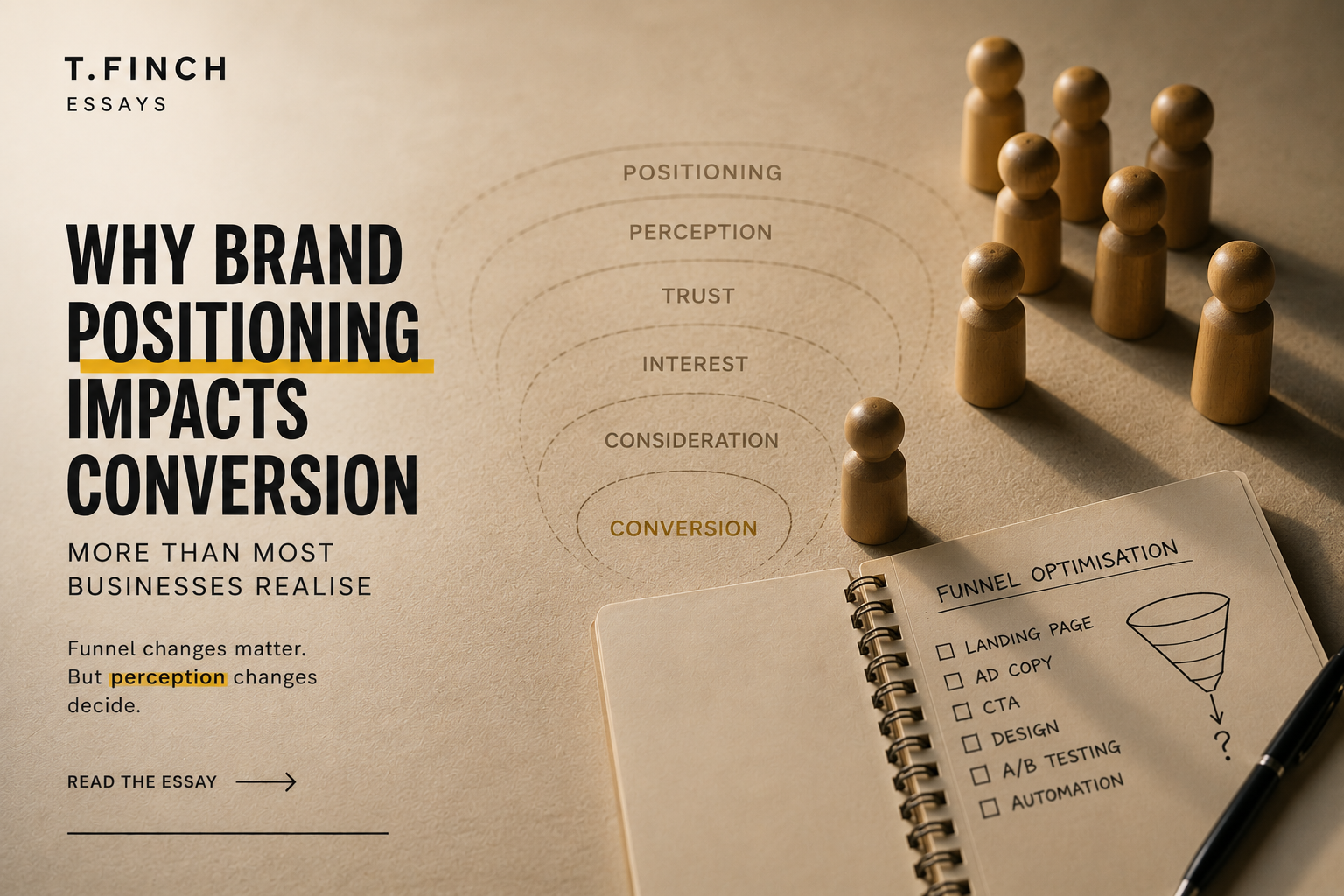
When businesses struggle with conversion performance, the first instinct is often to optimise the funnel. Companies begin adjusting landing pages, rewriting call-to-actions, testing creatives, refining advertisements, or improving user experience flows. These optimisations are valuable and often necessary. However, many businesses eventually reach a point where funnel optimisation alone stops producing significant results.
Despite improving technical performance, conversion rates remain inconsistent. Customer hesitation persists. Paid acquisition costs continue rising. Traffic increases, but buying confidence does not improve proportionally. At this stage, the issue is often deeper than the funnel itself.
Because conversion is not determined only by what happens inside the funnel. In many situations, the customer's perception of the brand entering the funnel has already influenced the outcome long before optimisation begins. This is where brand positioning becomes critically important.
Customers Rarely Enter Funnels Neutrally
One of the biggest misconceptions in modern marketing is the assumption that customers evaluate businesses objectively only after entering the sales process. In reality, buyers often arrive with pre-formed perceptions shaped by:
- brand communication,
- market positioning,
- visual consistency,
- social proof,
- customer reputation,
- messaging clarity,
- and perceived authority.
These perceptions create emotional assumptions before the customer consciously evaluates the offer itself. When positioning is strong, customers often enter the funnel with higher trust, stronger confidence, and lower resistance. The business already feels credible, differentiated, or relevant before detailed persuasion even occurs.
When positioning is weak, the opposite happens. Customers enter the funnel uncertain, skeptical, or emotionally disconnected. Even if the offer itself is competitive, the brand lacks the perception necessary to reduce decision-making friction effectively. This is why some businesses consistently convert better despite offering similar products, pricing, or services. The difference is often perception.
Funnel Optimisation Cannot Fully Compensate for Weak Positioning
Many businesses attempt to solve conversion issues purely through technical optimisation. They improve landing page structure, ad targeting, user interface, email sequences, checkout processes, or sales copy. These adjustments can absolutely improve efficiency. But when the brand itself lacks strategic positioning, optimisation eventually reaches diminishing returns.
This happens because the funnel is being forced to compensate for deeper trust and perception gaps. For example, if customers are unclear about what the brand truly represents, why it matters, what differentiates it, or whether it feels trustworthy, then every part of the funnel must work harder to create confidence from scratch.
"Strong positioning reduces the amount of persuasion required inside the funnel. Weak positioning increases it."
"Strong positioning reduces the amount of persuasion required inside the funnel. Weak positioning increases it."
Positioning Shapes Perceived Value
One of the most overlooked functions of brand positioning is its influence on perceived value. Customers do not evaluate businesses based purely on product specifications or pricing alone. They also evaluate meaning, relevance, trustworthiness, and perceived expertise. Positioning influences how customers interpret pricing, quality, authority, professionalism, and emotional relevance.
Without strong positioning, businesses often become vulnerable to price comparison and transactional decision-making. Customers struggle to understand why one option deserves preference over another. As a result, conversion becomes increasingly dependent on discounts, promotions, aggressive advertising, or short-term incentives. Over time, this weakens long-term brand equity and creates increasing acquisition pressure.
Trust Is Built Before the Conversion Moment
Many businesses focus heavily on the final conversion event itself while underestimating the psychological buildup occurring beforehand. In reality, customers continuously evaluate signals throughout the buyer journey. Every interaction contributes to perception: website experience, communication consistency, visual identity, tone of messaging, social presence, strategic clarity, and overall professionalism.
Strong positioning creates alignment across these touchpoints. When customers encounter a business with clear positioning, the experience feels more cohesive and credible. The brand communicates confidence and consistency, which naturally reduces hesitation during the buying process. Because ultimately, customers are not only buying products or services. They are buying confidence in the decision itself.
Strong Positioning Improves Marketing Efficiency
Brand positioning does not only influence conversion rates — it also impacts the efficiency of the entire marketing ecosystem. Businesses with stronger positioning often experience lower acquisition resistance, stronger organic referrals, improved customer retention, better audience resonance, and healthier long-term customer relationships.
Strong positioning allows marketing to amplify existing trust. Weak positioning forces marketing to manufacture trust repeatedly.
Final Thoughts
Conversion optimisation is important. Improving funnels, user experience, and campaign performance can create meaningful business growth. But conversion is rarely only a technical funnel problem.
Brand positioning shapes trust, perceived value, emotional relevance, and customer confidence long before the final purchasing decision occurs. As markets become increasingly competitive, businesses that focus only on tactical optimisation while neglecting strategic positioning may eventually face diminishing returns. Because sustainable conversion performance is not built through funnel mechanics alone. It is built through the strategic perception supporting the funnel itself.
— CLOSING NOTE FROM T.FINCH
If your business is experiencing the patterns described above, the deeper challenge is rarely campaign quality alone — it is usually strategic alignment beneath the campaigns. T.FINCH helps businesses build adaptive brand and marketing systems designed for sustainable, compounding growth.