
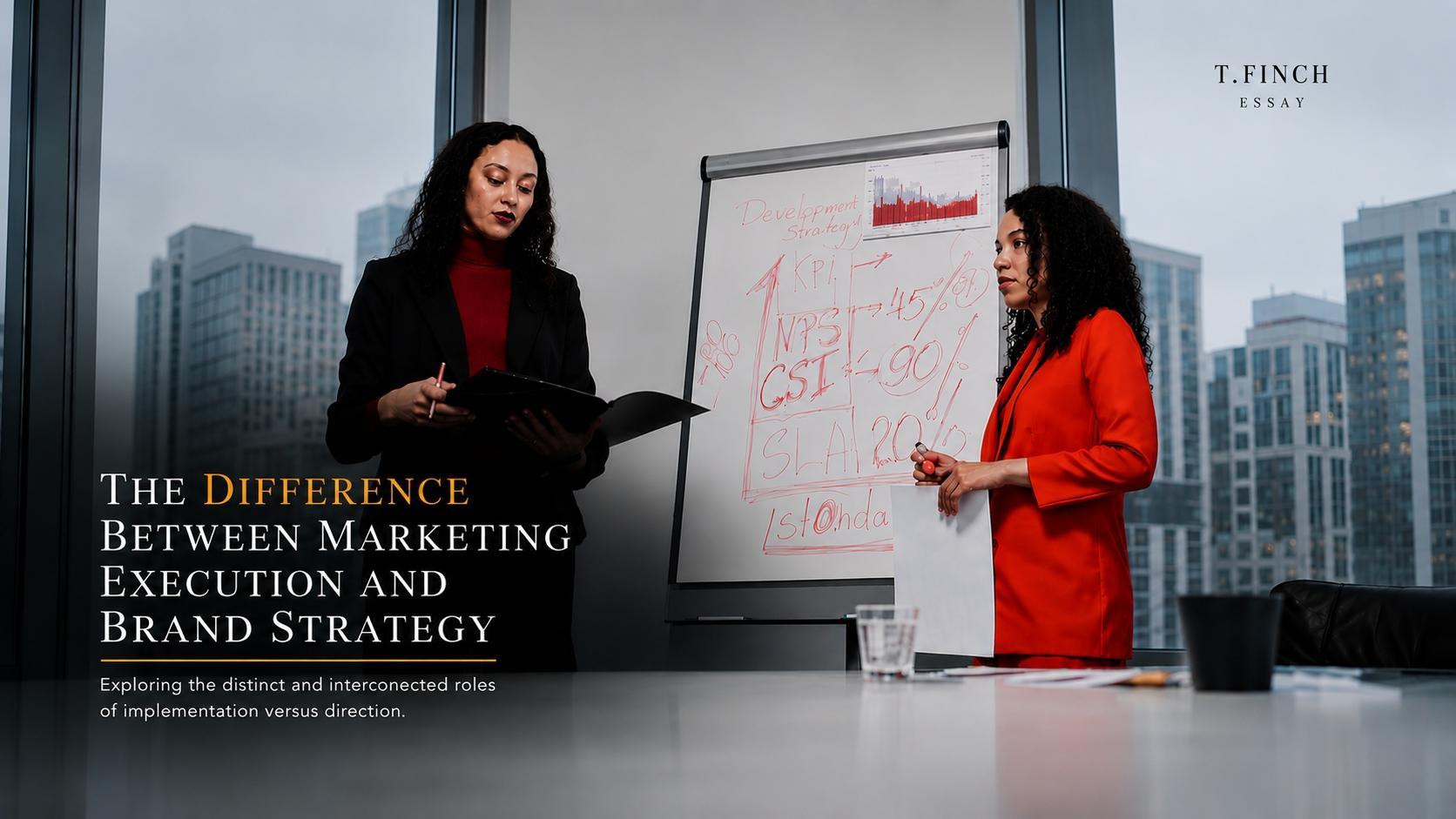
In modern business, marketing execution and brand strategy are often treated as if they are the same thing. Businesses commonly invest in campaigns, content production, advertisements, social media activity, and creative assets while believing they are "building the brand." In reality, many of these activities are forms of marketing execution — important components of growth, but not the same as strategic brand development.
This distinction matters far more than most businesses realise. Because while campaigns can generate visibility and short-term sales, strategy determines whether those efforts compound into long-term market strength. When businesses confuse execution with strategy, growth may initially appear successful, but inefficiencies often emerge later through rising acquisition costs, declining channel performance, inconsistent positioning, and weakened customer trust.
"The issue is not that execution is unimportant. The issue is when execution exists without a larger strategic foundation guiding it."
"The issue is not that execution is unimportant. The issue is when execution exists without a larger strategic foundation guiding it."
Marketing Execution Focuses on Immediate Activity
Marketing execution refers to the tactical implementation of marketing efforts. This includes activities such as:
- running advertisements,
- creating content,
- launching campaigns,
- managing social media,
- producing visuals,
- and generating short-term visibility.
Execution is designed to create movement. It helps businesses capture attention, generate leads, increase reach, and drive immediate engagement or sales opportunities. In many cases, strong execution can produce impressive short-term results. However, execution alone does not necessarily create long-term strategic advantage. Without clear strategic direction, campaigns often function as isolated activities rather than contributing toward a larger and more sustainable brand position within the market.
Brand Strategy Focuses on Long-Term Market Perception
While execution focuses on activity, brand strategy focuses on alignment and perception. Brand strategy shapes how the market understands the business, what the business represents, how it differentiates itself, who it serves, and why customers should trust or remember it. It provides the strategic foundation behind marketing decisions.
Unlike campaigns, strategy is not designed for immediate visibility alone. Its role is to create accumulated trust, recognition, and relevance over time. This is why strategy compounds. Each aligned interaction strengthens customer familiarity and reinforces market perception gradually. Over time, businesses with strong strategic alignment often develop stronger pricing power, healthier customer loyalty, lower acquisition resistance, and more sustainable growth efficiency.
Campaigns Can Sell — But Strategy Determines Sustainability
One of the reasons businesses confuse execution with strategy is because campaigns can produce visible short-term success. A strong advertisement may generate immediate conversions. A viral campaign may create rapid attention. A successful content strategy may increase engagement quickly. These outcomes are valuable.
However, short-term campaign success does not automatically mean the business has developed strong strategic positioning. In many cases, businesses experience strong initial growth while deeper structural weaknesses remain unresolved. Because the market is responding to tactical execution rather than accumulated brand equity, performance often becomes increasingly dependent on continuous marketing pressure.
Over time, this creates a dangerous cycle:
- campaigns must work harder,
- acquisition costs increase,
- retention weakens,
- and marketing efficiency gradually declines.
Without strong strategy underneath the execution, businesses often find themselves constantly restarting momentum rather than compounding it. This is one of the hidden costs of treating execution and strategy as interchangeable concepts.
Declining Channel Efficiency Is Often a Strategic Problem
Many businesses interpret declining marketing performance as a channel problem. When conversion costs rise or engagement weakens, companies often assume they need new creatives, new platforms, more advertisements, or more aggressive campaign execution. While optimisation matters, declining efficiency is frequently connected to deeper strategic issues.
For example, businesses with unclear positioning often struggle to maintain sustainable marketing efficiency because customers do not clearly understand why the brand matters, what differentiates it, or why it deserves preference over competitors. As a result, paid channels are forced to compensate for the absence of strong market perception. Strong strategy improves channel efficiency because customers already carry familiarity and confidence toward the business before interacting with campaigns.
Businesses Eventually Reach the Limits of Execution Alone
In earlier growth stages, execution often produces substantial results because businesses primarily need visibility and operational momentum. However, as businesses scale, the limitations of execution-only growth become increasingly visible. Eventually, businesses begin experiencing challenges such as inconsistent growth, rising acquisition costs, weaker differentiation, fragmented communication, and unstable customer loyalty.
At this stage, the primary issue is often not insufficient marketing activity. It is insufficient strategic alignment. The business may already be producing enough campaigns, content, and advertisements. What it lacks is a cohesive strategic system capable of making those efforts compound more efficiently over time.
Final Thoughts
Execution creates movement. Strategy creates direction. Campaigns can generate visibility and short-term results, but strategy determines whether those efforts accumulate into sustainable market positioning and long-term brand equity.
The strongest businesses understand that execution works best when guided by clear strategic alignment. Because while campaigns can sell temporarily, strategy is what allows growth to compound sustainably over time.
— CLOSING NOTE FROM T.FINCH
If your business is experiencing the patterns described above, the deeper challenge is rarely campaign quality alone — it is usually strategic alignment beneath the campaigns. T.FINCH helps businesses build adaptive brand and marketing systems designed for sustainable, compounding growth.