
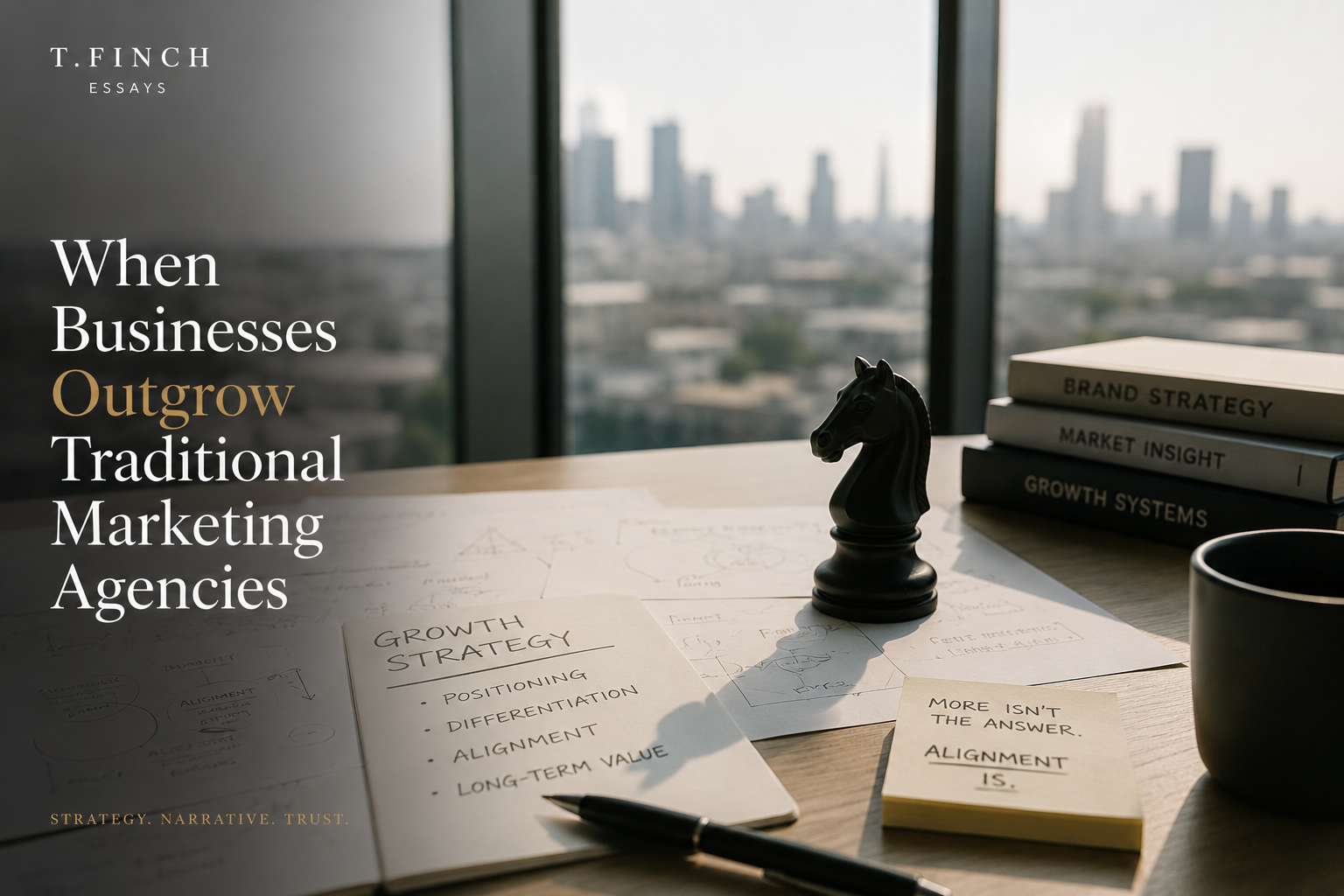
For many businesses, working with a marketing agency is an important stage of growth. In the early phases, execution support often solves immediate business needs. However, as businesses grow, the nature of their challenges begins to change. There comes a point where increasing execution alone no longer produces the same level of business progress.
Marketing activities continue, campaigns remain active, and content output increases — yet growth starts feeling fragmented, inefficient, or strategically unclear. This is often the stage where businesses begin outgrowing traditional agency relationships. Not because execution is no longer important, but because execution is no longer the main limitation.
Growth Complexity Changes the Nature of the Problem
In earlier growth stages, businesses often operate with relatively straightforward objectives: generate awareness, acquire customers, improve visibility, and drive short-term sales. Execution-focused agencies are typically effective in supporting these goals because the business primarily needs operational momentum.
But as companies scale, growth introduces increasing complexity. Businesses begin facing deeper strategic challenges involving:
- market positioning,
- communication consistency,
- customer perception,
- brand differentiation,
- scalability,
- and long-term growth direction.
At this stage, businesses often discover that marketing activities alone cannot solve structural growth limitations. The issue is no longer simply: "How do we market more?" The question becomes: "Are all parts of the business strategically aligned toward sustainable growth?" This is a fundamentally different problem.
More Marketing Does Not Always Solve Strategic Misalignment
One of the most common signs that a business is outgrowing a traditional agency relationship is when marketing output continues increasing while clarity continues decreasing. The business may still be running campaigns, posting content, and generating leads, but internally things begin feeling disconnected.
In many cases, businesses respond by increasing execution volume:
- more campaigns,
- more advertisements,
- more content,
- more social media activity.
But when the underlying issue is strategic misalignment, additional execution often amplifies the inconsistency rather than solving it. This creates a cycle where businesses become increasingly active in marketing while simultaneously becoming less strategically clear. Over time, growth efficiency begins declining because execution is operating without a unified strategic foundation.
Traditional Agencies Are Often Built Around Execution Models
This transition is not necessarily a failure of traditional agencies. Most agencies are structurally designed around execution support. Their systems are optimized for campaign delivery, creative production, media buying, content execution, and operational marketing management. These services remain valuable and necessary.
However, businesses entering more advanced growth stages often require a different type of support — one that focuses less on isolated marketing activities and more on strategic integration across the business. At this level, businesses need guidance around positioning clarity, long-term brand direction, communication alignment, customer understanding, and adaptive growth strategy. The business no longer simply needs someone to "run marketing." It needs strategic perspective capable of aligning marketing with broader business growth objectives.
Most Businesses Notice the Transition Too Late
There is rarely a single moment where a company suddenly realizes it has outgrown its agency model. Instead, the symptoms accumulate slowly over time. Businesses may begin experiencing inconsistent growth despite active marketing, rising acquisition costs, unclear market positioning, fragmented communication, weaker customer retention, or internal confusion around brand direction.
Because execution activity still exists, businesses often assume the solution is simply better execution. But eventually, they realize the issue is not the quantity of marketing — it is the absence of strategic alignment underneath it. Unfortunately, many businesses only recognize this after inefficiencies have already compounded significantly.
Strategic Guidance Becomes Increasingly Valuable at Scale
As businesses mature, strategic clarity becomes more valuable than execution volume alone. This does not mean execution becomes less important. In fact, execution often becomes even more critical as businesses scale. However, without strong strategic direction, execution can easily become fragmented and inefficient.
Strategic guidance helps businesses create alignment between brand positioning, customer perception, communication systems, operational growth, and long-term business direction. At this stage, the role of marketing evolves from isolated promotional activity into a broader growth system connected directly to business strategy.
Final Thoughts
Traditional marketing agencies play an important role in helping businesses build momentum and operational capability. But as businesses scale, growth challenges inevitably become more strategic in nature.
"Sustainable growth rarely depends on execution alone. It depends on how well the entire business is strategically aligned behind it."
"Sustainable growth rarely depends on execution alone. It depends on how well the entire business is strategically aligned behind it."
— CLOSING NOTE FROM T.FINCH
If your business is experiencing the patterns described above, the deeper challenge is rarely campaign quality alone — it is usually strategic alignment beneath the campaigns. T.FINCH helps businesses build adaptive brand and marketing systems designed for sustainable, compounding growth.