
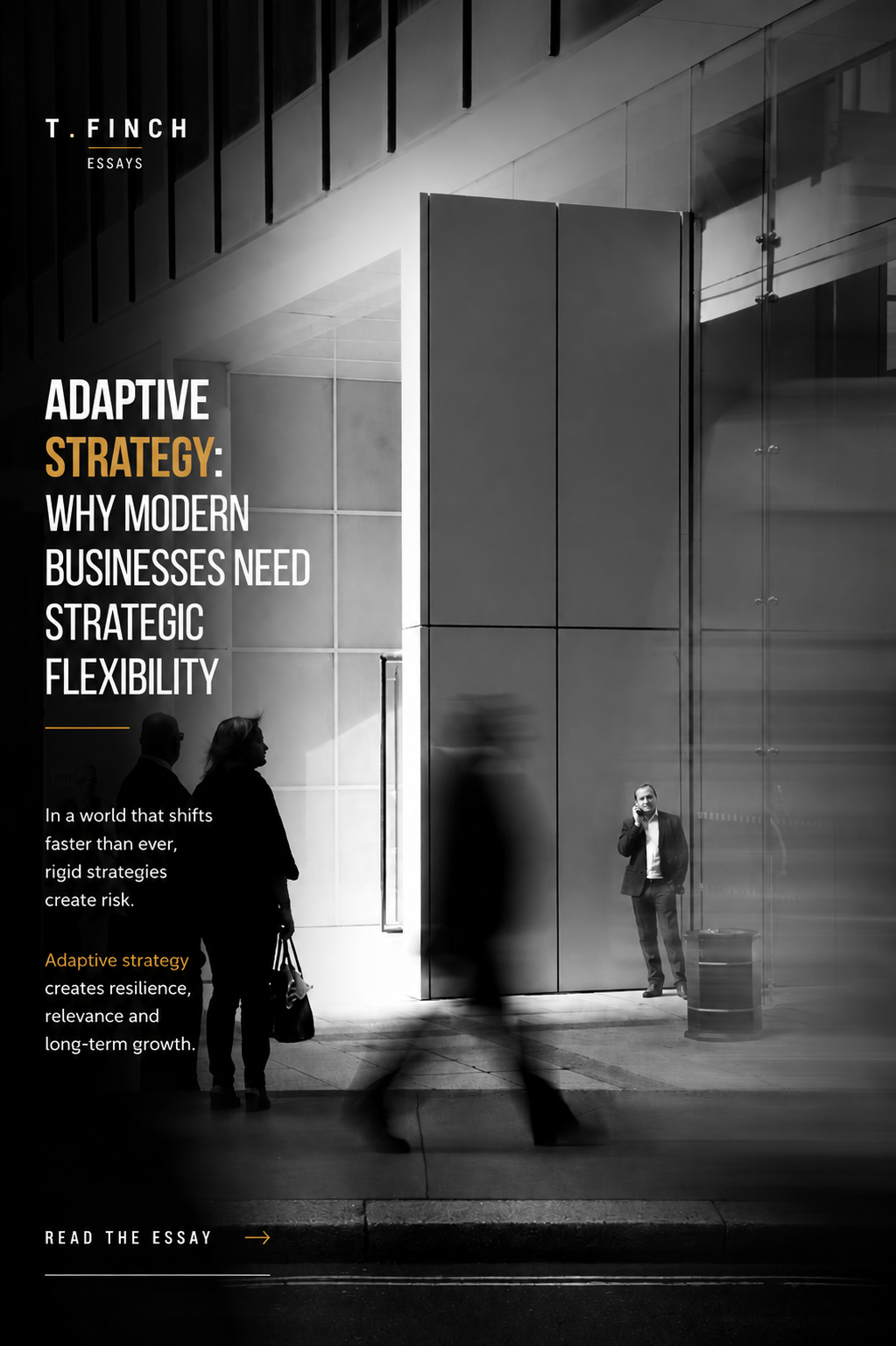
For decades, businesses were built around the idea of stability. Markets evolved slowly, consumer behavior remained relatively predictable, and competitive landscapes changed over longer periods of time. Today, that environment no longer exists.
Modern businesses now operate within markets shaped by rapidly shifting consumer behavior, evolving digital platforms, accelerating technological change, economic uncertainty, and increasingly fragmented attention. What worked six months ago may lose effectiveness far sooner than expected.
In this environment, the ability to adapt strategically has become far more valuable than rigid long-term planning alone. The businesses most likely to sustain growth are not necessarily the ones with the most fixed strategies, but the ones capable of maintaining strategic clarity while remaining flexible enough to evolve with changing market realities.
Static Strategies Were Built for Slower Markets
Traditional business strategies were designed around a world where industries changed gradually. Businesses could spend years refining a single operational model, marketing approach, or positioning direction with relatively predictable outcomes. However, today's business environment behaves differently. Markets now shift through:
- changing consumer expectations,
- platform algorithm updates,
- technological disruption,
- economic fluctuations,
- and rapidly evolving digital behaviors.
This does not mean long-term direction is no longer important. In fact, strategic clarity matters more than ever. But modern businesses can no longer rely on static execution models without developing the flexibility to respond intelligently to change. The challenge is no longer simply creating a strategy. The challenge is building a strategy capable of adapting without losing alignment.
Adaptability Is Not the Same as Constant Trend Chasing
One common misunderstanding about strategic flexibility is the assumption that businesses must constantly reinvent themselves to remain relevant. In reality, excessive reaction to trends often creates fragmentation and weakens long-term brand consistency. Adaptive strategy is not about abandoning direction every time the market changes.
It is about maintaining a strong strategic foundation while remaining flexible in execution, communication, and market response. Businesses with adaptive strategy understand what their core positioning represents, what value they bring to the market, who they serve, and how they want to be perceived. Because these foundations are clear, they can evolve tactically without losing strategic identity.
Consumer Behavior Is Evolving Faster Than Most Businesses Realise
Modern consumers are exposed to massive information volume, shorter attention cycles, changing content consumption habits, and increasingly competitive digital environments. Customer expectations now evolve far more quickly than in previous decades. Audiences become more selective, more skeptical, and more sensitive to relevance and authenticity.
Businesses that rely too heavily on outdated messaging, rigid communication models, or fixed customer assumptions often struggle to maintain long-term engagement. At the same time, businesses that adapt too aggressively without strategic consistency risk diluting their identity and confusing their audience.
Strategic Flexibility Creates Long-Term Resilience
Businesses operating with rigid systems often struggle when markets shift unexpectedly. Adaptive businesses, however, are typically better prepared to navigate uncertainty because their systems are built around continuous evaluation and adjustment rather than static repetition. This flexibility allows businesses to:
- respond to market shifts more effectively,
- adjust communication strategies,
- identify changing customer behavior earlier,
- and refine growth direction without completely restructuring the brand.
Importantly, adaptive strategy does not eliminate uncertainty. Instead, it improves a business's ability to remain aligned despite uncertainty. In increasingly volatile markets, this becomes a major long-term competitive advantage.
Strategic Clarity Makes Adaptation Possible
Ironically, businesses are often only able to adapt effectively when their strategic foundation is already clear. Without clarity, adaptation easily becomes random experimentation. Businesses begin reacting emotionally to trends, competitors, or short-term performance fluctuations without understanding whether those decisions align with their long-term positioning.
"Adaptive strategy is not about becoming less structured. It is about becoming strategically structured enough to evolve sustainably."
"Adaptive strategy is not about becoming less structured. It is about becoming strategically structured enough to evolve sustainably."
Final Thoughts
Modern business environments no longer reward rigidity the way they once did. The businesses most likely to sustain long-term growth are often the ones capable of balancing consistency with adaptability.
Adaptive strategy is not about abandoning long-term direction. It is about creating systems capable of responding intelligently to uncertainty without losing alignment. In today's environment, strategic flexibility is no longer optional. For many businesses, it has become one of the most durable competitive advantages available.
— CLOSING NOTE FROM T.FINCH
If your business is experiencing the patterns described above, the deeper challenge is rarely campaign quality alone — it is usually strategic alignment beneath the campaigns. T.FINCH helps businesses build adaptive brand and marketing systems designed for sustainable, compounding growth.